
Underwater Granulation Production Line
Learn More
Introduction
 Twin-Screw Underwater Granulation Unit
A twin-screw underwater pelletizing system typically consists of a start-up valve, die head, die head temperature control system, pelletizer head, water system and fittings, particle dewatering machine, and control system. Underwater pelletizing operation mode: When uniform, high-temperature molten material enters the die head flow channel from the end of upstream equipment (reactor, screw extruder, melt pump, etc.), the material is immediately cut into droplets by the high-speed rotating pelletizer blades as it leaves the die orifice and enters the processing water. Due to the physical property of maximizing particle specific surface area and the temperature difference between the molten droplets and the processing water, the droplets solidify and form near-spherical particles. This "hot-cut then water-cooled" pelletizing method makes it well-suited for pelletizing materials with poor molten strength, high viscosity, and high heat sensitivity.
Flow Chart
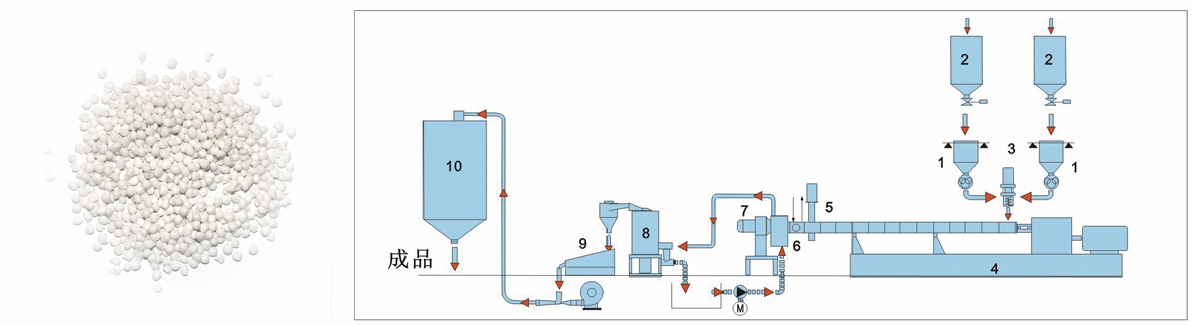
1. Loss-in-weight weighing scale 2. Raw material silo 3. Mixing head 4. Main unit 5. Start-up valve 6. Screen changer
7. Underwater hot pelletizer 8. Centrifugal dewatering machine 9. Vibrating screen 10. Finished product silo
Application
1. Strong heat and mass transfer capabilities, narrow dwell time distribution, extremely high heat transfer and diffusion surface area, and continuous operation mode provide unique advantages for reaction systems under harsh conditions such as high viscosity and high temperature.
2. Continuous polymerization reaction extrusion of PUR, PA, POM, PEI (polyetherimide), PC, PMMA, PBT, PPS, etc., as well as dynamic vulcanization, crosslinking, grafting, chain extension, and other reactive extrusion processes.
Particle Mass Advantage
1. Optimized particle shape, resulting in smooth and uniform particle surfaces, resembling water droplets or spheres;
2. High particle density and good flowability;
3. Eliminates particle oxidation;
4. Reduces adhesion;
5. Facilitates operation;
Production And Operational Experience
1. One-button start-up, fully automated continuous production;
2. Ultra-hard alloy die head, two-year warranty;
3. No sharpening required, blades do not need replacement or sharpening within one year;
4. Shorter curing time, less space required, and lower cooling water demand;
5. Fully enclosed production, clean environment;
6. Low noise, no dust pollution;
System Advantages
1. Capable of processing almost all polymers;
2. Flexible pelletizing head and blade clamping design allows for blade replacement within 2-3 minutes, resulting in high production efficiency and good stability;
3. Innovative die head temperature control design avoids material solidification and dead holes in the die holes;
4. Blade and die are precisely fitted, eliminating particle "tails";
Typical Material Granulation Applications
Thanks to the advanced principles and technology of underwater pelletizing, Hanyi's underwater pelletizing system can handle pelleting of almost any material. For materials with poor melt strength, high viscosity, and high heat sensitivity, such as pure PP, which traditional pelletizing equipment cannot process, Hanyi's underwater pelletizing system can handle them with ease.
Materials suitable for underwater granulation include (but are not limited to) the following:
▶ Thermoplastic Plastics:
Polyolefins (generally referring to homopolymers and copolymers of ethylene, propylene, and butene)
Polyethylene (PE) and its variants (LDPE, MDPE, HDPE, LLDPE, VLDPE, UHMPE);
Chlorinated polyethylene (CPE), cross-linked polyethylene (XLPE), ethylene-vinyl acetate copolymer (EVA);
Polypropylene (PP), chlorinated polypropylene (PPC), reinforced polypropylene (RPP)
Polybutene (PB)
▶ General Engineering Plastics:
ABS resin (acrylonitrile butadiene styrene)
Nylon (PA)
Polyoxymethylene (POM): homopolymer, copolymer
Polycarbonate (PC)
Polystyrene (PS)
▶ Others:
Thermoplastic polyester resins: such as polyethylene terephthalate (PET), polybutylene terephthalate (PBT).
Polymethyl methacrylate (PMMA) resin
Thermoplastic elastomers:
Styrene-based thermoplastic elastomers (TPS): such as SBS, SIS, SEBS, SEPS, SEEPS, etc.
Polyolefin-based thermoplastic elastomers (TPO, TPE-O): S-TPO (single-infiltration type), factory-produced TPO, vulcanized TPV (PP/EPDM)
Polyurethane-based thermoplastic elastomers (TPU)
Ester-based thermoplastic elastomers (TPE)
Polyamide-based thermoplastic elastomers (TPA)
Material processable hardness range (Shore hardness): 0A~75D, eliminating surface adhesion.
▶ Blended Modified Materials:
1. General-Purpose Masterbatch
PE, PP, ABS, EVA + Pigment + Other Additives
2. Filler Modified Materials
PE, PP, EVA + Calcium Carbonate, Titanium Dioxide, etc.
PP, PA, ABS + Magnetic Powder, Iron Powder, Ceramic Powder, etc.
3. Blended Modified Materials
PE, PP, PS + SBS
PP, PA + EPDM
4. Glass Fiber Reinforced Materials
PP, PBT, ABS, PA6, PA 66, PC, POM, PPS, PET + Long and Short Glass Fiber/Crystal Powder Coating
PP, PBT, ABS, PA6, PA66, PC, POM, PPS, PET + Carbon Fiber
5. Functional Masterbatches
Based on PP, PE, and cable materials
▶ Commonly used additives include:
Calcium carbonate, titanium dioxide, carbon black, talc, EPDM rubber, EPR rubber, glass fiber, pigments, and other additives or stabilizers, such as paper sheets, anti-caking agents
Antioxidants, antistatic agents, plasticizers, flame retardants, etc.
Ultra-low material retention underwater pelletizing system enables rapid product changeover, meeting food-grade and pharmaceutical-grade product requirements.
Spherical and elliptical particles offer better flowability in subsequent applications;
▶ Hot Melt Adhesive HMA:
EVA type
EPS
PA, etc.
Particle products can be unloaded at temperatures above 90°C. In addition to the underwater granulation system, Hanyi Machinery can also provide upstream equipment for hot melt adhesive production;
Ultra-low temperature liquid nitrogen cooling pelletizing can achieve demanding food micro-particle granulation.
Particle Size Range For Underwater Granulation
The underwater pelletizing system employs a special mold and cutting chamber design, suitable for the production and processing of various standard and micro-particles.
1. Micro-particles: 0.2mm-1.0mm; e.g., for PP foam granules
2. Standard particles: 1.0mm-5mm
3. Large particles: 5mm and above
The achievable particle size primarily depends on the processing properties of the material and is determined by matching the die discharge port, pelletizer head model, and dewatering machine filter screen.
Technical Parameters
| Parameters (Model) | Screw Diameter (mm) | Main Power (kW) | Maximum Speed (r/min) | Output (kg/h) |
| HKY-20 | 21.7 | 4 | 600 | 2-10 |
| HKY-35 | 35.6 | 15 | 600 | 80-180 |
| HKY-50 | 50.5 | 45 | 500 | 150-350 |
| HKY-50B | 50.5 | 55 | 600 | 200-350 |
| HKY-52 | 51.2 | 75 | 600 | 250-400 |
| HKY-65 | 62.4 | 75 | 500 | 450-600 |
| HKY-65B | 62.4 | 90 | 600 | 450-650 |
| HKY-75 | 71 | 110 | 500 | 600-850 |
| HKY-75B | 71 | 132 | 600 | 600-900 |
| SKY-75 | 71 | 280 | 600 | 800-1500 |
| HKY85 | 81.5 | 220 | 600 | 700-800 |
| HKY95 | 93 | 325 | 600 | 800-1200 |
+86-25-84439591
Address: No. 19 Yunlong Road, Tao Wu Industrial Park, Jiangning District, Nanjing City
Mobile phone: 13801580926 / 13770651639
Email: admin@chinakaiyou.com
Copyright © 2025 Nanjing Kaiyou Rubber & Plastic Machinery Co., Ltd.